The American Scholar: Ephemeral Art
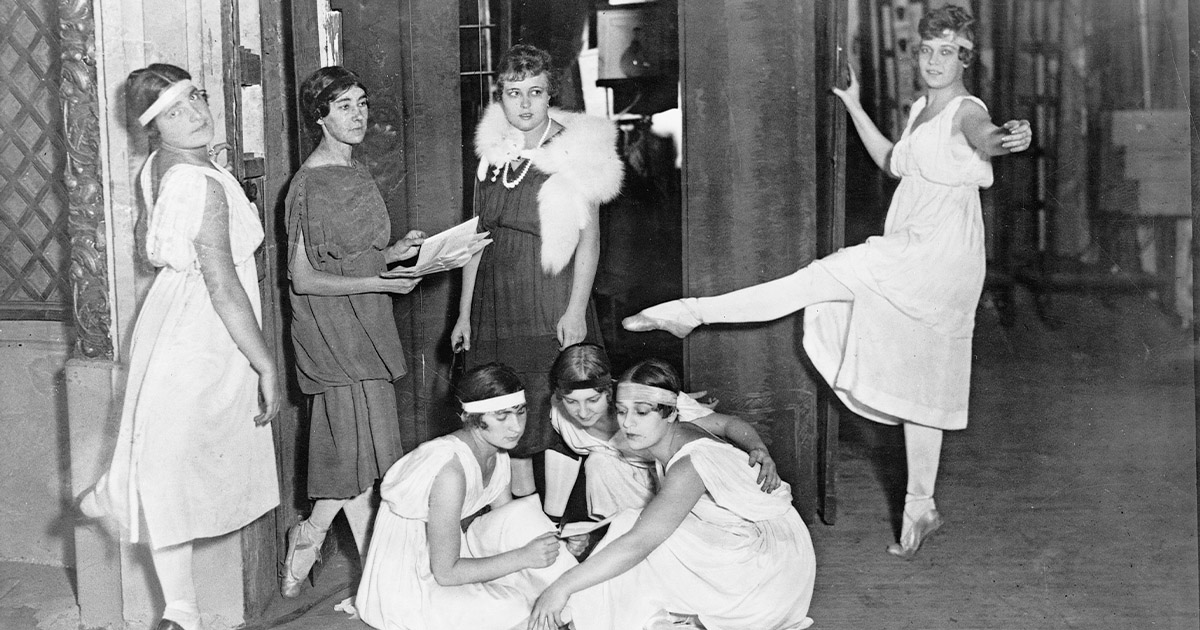
Rehearsal of the Ballets Russes in New York, 1916 (Library of Congress/Wikimedia Commons)
Diaghilev’s empire: how the Ballets Russes fascinated the world by Rupert Christiansen; Farrar, Straus and Giroux, 384 pages, $35
“Your Majesty,” Sergei Diaghilev told King Alfonso of Spain at a reception in Madrid in 1916, “I am like you. I do not work, I do nothing. But I am indispensable. In Diaghilev’s empire: how the Ballets Russes fascinated the world, Rupert Christiansen, dance critic of the spectator, clearly highlights how both indispensable and unwavering Russian impresario Diaghilev was as he pursued his dream of showcasing Russian art and music and commissioning groundbreaking collaborations.
The Ballets Russes, founded by Diaghilev in 1909, have never performed in Russia. Many artists fled the country during the Bolshevik Revolution, after which Diaghilev, homesick, went into permanent exile in Europe. Christiansen’s book, which commemorates the 150th anniversary of Diaghilev’s birth, also coincides with Russia’s invasion of Ukraine and its withdrawal from the international cultural scene. Prominent Russian artists such as soprano Anna Netrebko and conductor Valery Gergiev have themselves been exiled from many Western theaters for their refusal to convict Vladimir Putin, while touring Russian ensembles have seen concerts cancelled. Prominent Ukrainian dancer Artem Datsyshyn was killed in the fighting, and Russian artists, including Bolshoi ballerina Olga Smirnova, emigrated.
Christiansen, of course, could never have predicted anything when he began working on the book, which describes the history of ballet in Russia and the conservatism that initially propelled Diaghilev abroad. Like opera, ballet has its origins in the court culture of the French and Italian Renaissance, but declined in 19th-century Europe, where it had “neither intellectual content nor aesthetic dignity” and served primarily to entertain lustful old men. In Russia, meanwhile, the Mariinsky and Bolshoi ballets were controlled by the Tsar. Although less whimsical than its Western counterpart, the art form, writes Christiansen, “was kept in aspic and constrained by protocol”. When Diaghilev tried to mount a bold new production by Léo Delibes Sylvia in Saint Petersburg, he clashed with the establishment, then dominated by the Frenchman Marius Petipa.
Diaghilev grew up in a wealthy and close-knit family of vodka distillers in the western Russian city of Perm, where his parents regularly hosted musical parties. He was well educated and during his youth his stepmother encouraged a positive attitude which later served him well as an impresario. Passionate about opera and painting, he had hoped to become a composer but gave up when Nikolai Rimsky-Korsakov outright rejected his musical ambitions. Instead, Diaghilev studied law in St. Petersburg, where he edited an art journal and curated exhibitions. He often felt blocked by the conservatism of the Russian art world.
Diaghilev, who spoke good French, turned to Europe to realize his ambitions. He successfully organized an exhibition of Russian art in Paris in 1906, and the following year organized a series of orchestral concerts featuring music by Russian composers and the superb Russian bass Fyodor Chaliapin. In 1908, Diaghilev staged a highly successful production of Modest Mussorgsky’s opera Boris Godunov in Paris. Ballet was not one of his main passions, but he sensed an opportunity and used his extensive knowledge of the worlds of music and art to commission collaborations with Igor Stravinsky, Sergei Prokofiev, Claude Debussy, Pablo Picasso, Wassily Kandinsky, Henri Matisse, Joan Miro, Jean Cocteau, Max Ernst and Coco Chanel. These remarkable artistic collaborations allowed Diaghilev (a Wagnerian) to achieve the philosophy of the German composer of Gesamtkunstwerk (“total work of art”).
Diaghilev, who had admired the fluid movements of barefoot American dancer Isadora Duncan, was keen to go beyond pretty tutus and felt Parisians were aesthetically adventurous. The irresistibly “primitive” choreography of Michel Fokine for the Polovtsian dances of Alexander Borodin was a success. Audiences also turned to other works of Russian folklore choreographed by Fokine, including Stravinsky Bird of Fire and Petrushka . The sumptuous sets and costumes of Léon Bakst for Rimsky-Korsakov Scheherazade dazzled the Parisian public.
Everything was just an accumulation for Stravinsky The Rite of Spring, its dissonant and polyrhythmic score disconcerting the dancers during chaotic rehearsals. Diaghilev, always a savvy public relations man, invited some stars to the opening night and issued a press release declaiming “truly a new sensation that will no doubt provoke heated discussions”. At the first riot in 1913, critics scoffed at the dissonance of the music and what they considered ugly and inelegant choreography, but subsequent performances in Paris and London were uneventful.
Another of Diaghilev’s goals in Paris was to shift the focus from female dancers to male dancers – still prominent in Russia, unlike Western Europe. He recruited the handsome black-eyed Vaslav Nijinsky, a brooding and unsociable man of immense talent who, in 1912, choreographed Debussy’s play Afternoon of a Faun and scandalized Parisians with a glowing and highly suggestive dance. Diaghilev loved and actively courted scandal and was delighted when Nijinsky was fired from the Mariinsky after he refused to wear shorts over his tights and then shocked the Tsar’s mother with his bulges. According to one of Nijinsky’s friends, “There may be other dancers who actually jumped higher, but… Nijinsky got close to the stars and made you completely forget the earth.”
Diaghilev was openly gay and had endless flings with his young dancers, some of whom were heterosexual. Dancer Léonide Massine compared his own sexual encounters with Diaghilev to kissing “a beautiful fat old lady”. Diaghilev, extremely competitive and often vengeful, was outraged when Nijinsky and Massine dared to marry women. He fired them both. Nijinksy suffered from depression and was diagnosed with schizophrenia in 1919. Diaghilev also had a strong sense of female talent, promoting Tamara Karsavina, Anna Pavlova and Alicia Markova, among others.
A formidable businessman, Diaghilev mixed his personal finances with those of the company. The Ballets Russes have always been in a difficult financial situation, often being bailed out by super-rich patrons. After Diaghilev died in Venice in 1929 from complications of diabetes (following a final fling with a 16-year-old émigré composer), the company’s sets and costumes were sold to an American impresario to pay off his huge debts.
Before the Great War, the Ballets Russes had few competitors, and after Diaghilev’s death, experts declared that the ballet itself would die without its energetic impresario. Yet the Ballets Russes have been resurrected as two companies with confusingly similar names. Christiansen briefly describes the post-Diaghilev era, including the “baby ballerinas” promoted by George Balanchine (who became one of the few weighted figures in the Ballets Russes), Sadler’s Wells Ballet (now the Royal Ballet), and Balanchine’s School of American Ballet in New York. It also addresses the representation of ballet in popular culture, as depicted in works such as Noel Streatfeild’s 1936 book, ballet slippers and the Disney cartoon Fancy (1940).
Opera, classical music and ballet have long been considered to be on their deathbed. As early as 1864, Charles Dickens declared that “the ballet is dead and gone”. The ballet is not dead, of course, but as Christiansen writes, it is certainly ephemeral: “Carved into the air, the great dance vanishes like a perfume. It has a short and uncertain life after the death of its parents: very few choreographies have the eternal force of poetry or painting. But in his gripping account of Diaghilev’s life and art, Christiansen gave something that will last.