My father’s bad seats at the opera
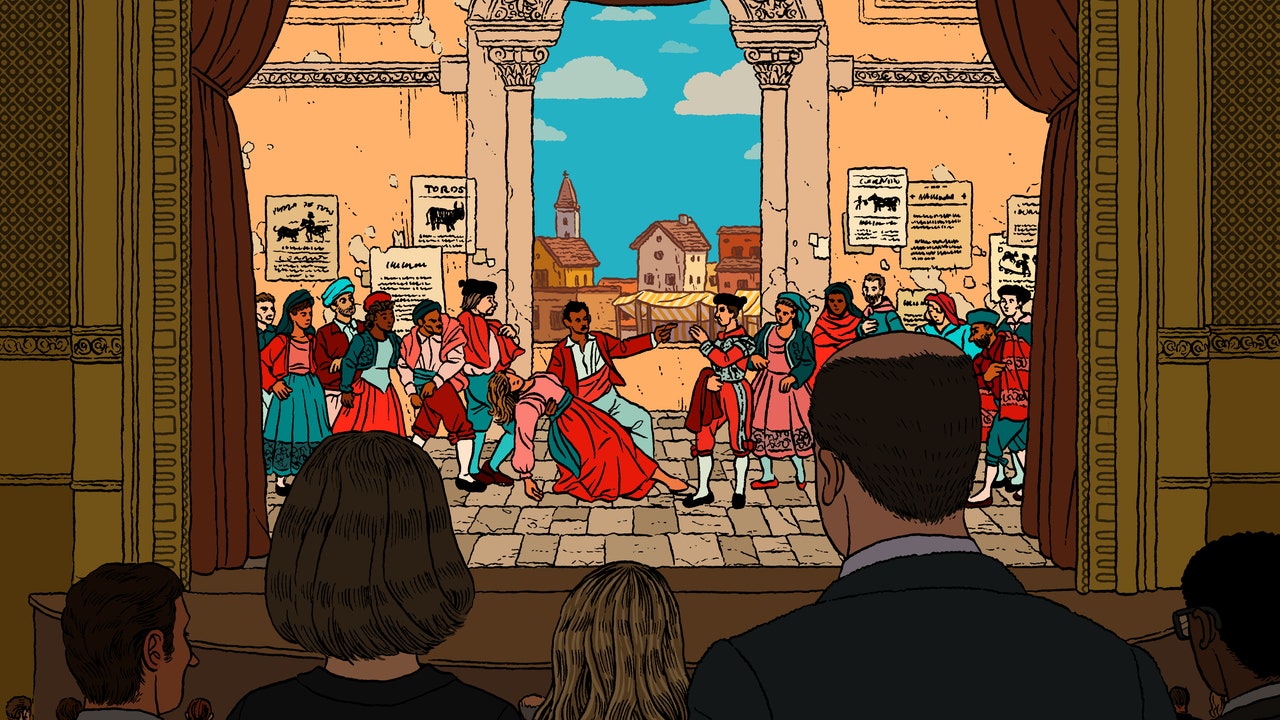
A regular feature of my father’s pocket diaries of the 1950s are his entries about performances he attended at the wanton-destroyed old Metropolitan Opera House on Thirty-Ninth Street, usually with one or the other family member. He quoted the names of operas, singers and conductors, and gave a laconic opinion, generally very favorable (“excellent”, “beautiful”, “exceptional”), even if he found here and there something to criticize, like the duration of a “Figaro” (“endless, from 8h to 11h45”). On rare occasions, he wrote down a chance event of the evening, for example: “At the intermission [of Mascagni’s “Cavalleria Rusticana” and Leoncavallo’s “Pagliacci”] drinks with Janet in the lobby of the Grand Tier (Scotch for me, Tom Collins for Janet). Last representation of our subscription.
Our seats were not on the Grand Tier – which was the third tier of seating, above the orchestra and dressing rooms – but on the fourth tier, called the Dress Circle, above which rose two other tiers, the Balcony and the Family Circle. Once I sat in the vertiginous upper floor; the singers’ voices carried, though they themselves were barely visible, tiny figures of ridiculously gesticulating dolls. They became more visible at the dress circle, but were still too far off to be registered as the characters they represented. Their expressions could only be made out through binoculars. I don’t remember that we resented our seats and wanted better ones, any more than we resented the riches of the rich and aspired to be rich ourselves. The Dress Circle was what we could afford and our place.
Later, I had the opportunity to sit in orchestra and box chairs, and see what I had only briefly glimpsed while accompanying my father: the full play of emotion on the faces singers. I remember my own almost hysterical emotion as I watched – from the perspective of a perfect orchestra seat – Renée Fleming and Dmitri Hvorostovsky stage the scene of their tormented separation at the end of a Met performance of “Eugene Onegin”. Hearing them was only part of what the composer wanted us to experience.
Unequal audience experience is intrinsic to the performing arts and is unique to them. Literature, painting and sculpture are mediums of equal opportunity. A rich reader’s experience of “Anna Karenina” is no more intense than that of a poor reader. The hedge fund owner and the secretary see exactly the same “Raft of the Medusa”. But only the hedge fund owner can see the look on Azucena’s face when she relives having thrown the wrong baby into the fire. Attempting a fairer jolt with opera are the Met’s Live in HD performance films. Here we all have great seats, so to speak, but in a way it’s not the same as being at the opera. There is something missing from these films. Or perhaps, more accurately, something has been added – the gigantic close-up – that dulls the magic that emanates from even the ugliest seats in the opera house after the lights go out and the opening bars of the opening sound.
I felt this magic during these performances in the fifties. But I also felt the boredom of prolonged misunderstanding. Surtitles had not yet been invented. Most of the time, what the characters said was a riddle. In the interval between arriving at our seats and the start of the opera, we desperately read the plot synopsis in the program, but that didn’t help much. Hearing great tunes sung by great singers was exhilarating; sometimes it was almost enough. But accompanying my father to the opera was not something my sister Marie and I argued about, or that my mother was eager to do. Sometimes, according to the newspapers, my father had to ask a distant relative or family friend to take the second seat of the fierce underwriting.
In his entry on the evening “Cavalleria” and “Pagliacci”, with his Tom Collins and his Scotch at the Grand Tier, he also noted that a performance of the couple in 1911, at the Národní Divadlo, or National Theatre, in Prague, was his first experience of opera. He was ten years old. It reminded me of the memory of my first opera: “Carmen” by Bizet, to which my father took me when I was very young – maybe also ten years old – performed not at the Met but in a small theater in Manhattan. The memory is indistinct – I don’t hear or see anything from the performance – but it must have made a deep impression, because ‘Carmen’ remained my favorite opera. I almost know it by heart. In my head, I hear the metallic sound of the children’s choir that comes at the beginning of the opera, and the silence that falls on the audience during the love duet of the first act of Micaëla and Don José. I go to “Carmen” whenever I can. I saw a Swedish version in which Carmen sang the Habanera lying on her back; I saw a film version set in South Africa, in which Don José was a cop driving a police van; I remember “Carmen Jones”, an all-black version set during World War II – there wasn’t a version I didn’t like. “Faust,” by Bizet’s mentor Gounod, is another of the operas that delight me wherever I sit. Both share a quality of Frenchness that my parents, as cultured Czechs living in Prague in the twenties and thirties, were alive to. French was their third language (German their second), they were well versed in French literature, and France was a frequent vacation destination.
It was my first stay in France, in 1960, with my first husband, which caused my own chronic case of Francophilia. I don’t know what kind of impervious boor you have to be not to notice that in France everything is better than anywhere else. There is a sort of atavistic aesthetic rooted in the French soul. The smallest objects of daily use are touched by beauty. The music of Bizet and Gounod participates in this tropism towards the elegant and the pleasant. “Hail, abode chaste and pure,” the famous tenor aria from “Faust,” with its unearthly high C, is a particularly vivid example of the delight my father sought – and found – in the old opera of his new country. ♦
This is from “Still Pictures: On Photography and Memory”.