City Ballet celebrates “the father of American ballet”
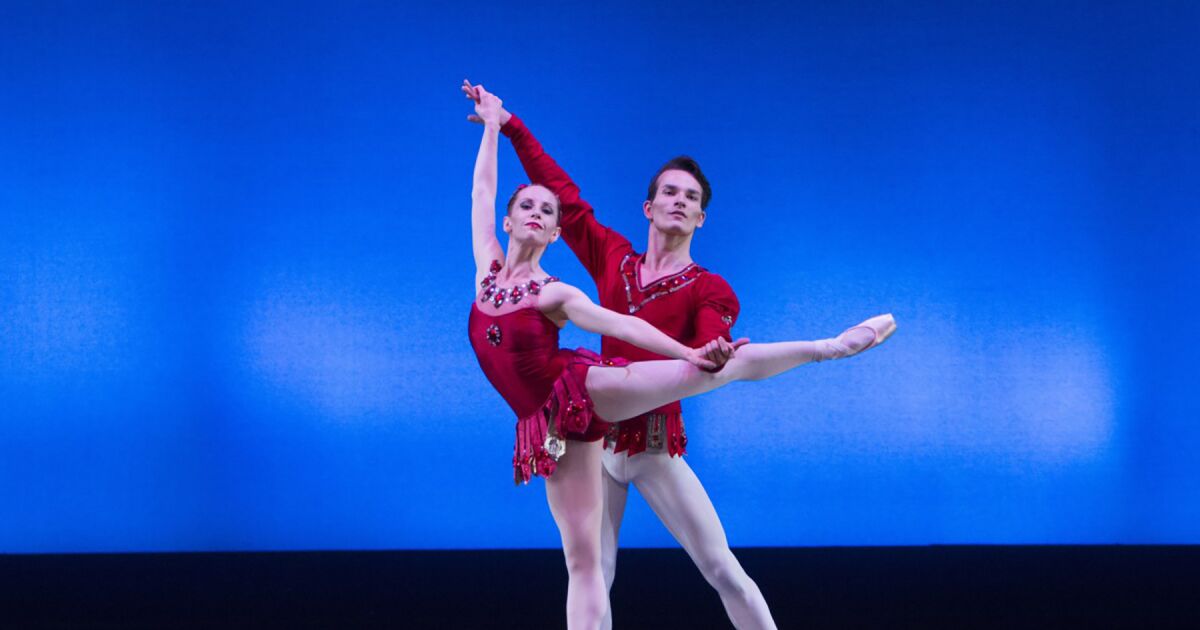
San Diego City Ballet Artistic Director Steven Wistrich is unequivocal when he calls the legendary Russian-born George Balanchine “the father of American ballet.”
“He created a whole new path for choreographers who followed in his footsteps and works that will live on after our passing,” he said. “When you dance to his choreography, you feel like it was made for you, that no other step could be better to the music you’re dancing to.”
City Ballet continues its 30th anniversary celebration with its 21st Balanchine presentation: “From Balanchine to Martins: 20th Century Masterworks” will be performed November 12 and 13 at the Balboa Theater downtown, then November 17 at the California Center for the Arts, Escondido.
The program includes Balanchine’s playful and athletic ‘Rubies’ from his ballet ‘Jewels’, performed to Igor Stravinsky’s ‘Capriccio for piano and orchestra’. The staging is provided by Zippora Karz, coach of the George Balanchine Trust, former solo ballerina of the New York City Ballet that Balanchine co-founded (with Lincoln Kirstein).
“Divertimento” by Balanchine is performed for the very first time by members of the City Ballet company. It is danced to “Le Baiser de la Fée” by Stravinsky (“Le Baiser de la Fée”).
Rounding out the program is “Ash,” choreographed by Peter Martins. “He was the person Balanchine had chosen to replace him as Artistic Director (of NYC Ballet) before he passed away,” Wistrich said. “He was a former principal dancer at the time. He was a wonderful choice. Imagine following in the footsteps of the master, but he held on.
“We’ve only danced once before and the audience just sat there in awe, it was so athletic. It’s very fast. Lots of jumps, lots of inventive turns and partnership. It’s like a high-speed train.
Martins’ son, Nilas, is also a former NYC Ballet principal dancer and directs both “Ash,” which is danced to music by Michael Torke, and “Divertimento” for this City Ballet presentation.
Karz was part of Balanchine’s last group to be chosen for NYC Ballet’s School of American Ballet and was part of the first group brought into the company itself by Peter Martins and Jerome Robbins. She would perform for NYC Ballet for 16 years, from 1983 (the year Balanchine died) until 1999. She became repetitive the same year she retired as a dancer.
“Rubies” is the “ninth or 10th” ballet she has staged for City Ballet, she said.
“I love having relationships with companies because you get to know the directors and the dancers,” Karz said. “It’s very personal. I love working with the City Ballet of San Diego. They really like Balanchine.
Karz worked with Balanchine during his early years in New York. “I was lucky,” she said, “to catch the end of his life. To have your life touched by such a genius, and all the great dancers and choreographers he has attracted, has been a profound experience. You are never the same again.
Echoing Wistrich’s assessment that George Balanchine “completely revolutionized ballet as we know it”, Karz considers the man born Georgiy Melitonovich Balanchivadze a visionary and a game-changer.
“Balanchine fell in love with America when he came here (in 1933) from Russia,” she said. “He loved the fast pace of New Yorkers. He loved the uninhibitedness of their movement. He put that in his dances. He wanted everything faster, bigger, more energy. If you are in a Balanchine ballet, each dancer in the ballet is dancing. Not just those featured. Balanchine-inspired choreographers also followed suit and allowed the corps de ballet to have as much dance and focus as the principal dancers.
“Rubies”, which she stages for this presentation of City Ballet, is an ideal manifestation of what Karz sees as the artistic cohesion between Balanchine and Stravinsky.
“They had a way of working with each other where Balanchine captured Stravinsky’s music perfectly. When he (Balanchine) met Stravinsky in the 1920s, he was very young. The relationship was special. Balanchine said: “Listen to the music, see the dance”. A Balanchine/Stravinsky ballet like ‘Rubies’ is a perfect example.
For Karz, “there is nothing like doing a Stravinsky and Balanchine ballet. We have the impression of playing on stage, of being able to explore, to expand, to let go. You can express a part of yourself, the music and the choreography. It is the essence of life and art.
Wistrich says Karz “loves directing. She is very passionate about Balanchine’s work and wants to make sure the public will see what his vision was. She is very meticulous and a great person to work with.
Karz, who is diabetic, is also the author of the cleverly titled memoir “The Sugarless Plum” and the children’s book “Ballerina Dreams.” She lived her own dream as a ballerina and now helps others achieve theirs.
City Ballet of San Diego: “From Balanchine to Martins: 20th Century Masterpieces”
When and where: 8 p.m. Nov. 12 and 2 p.m. Nov. 13 at the Balboa Theater, 868 Fourth Ave., Downtown, and 7:30 p.m. Nov. 17 at the California Center for the Arts, Escondido, Concert Hall, 340 No. Escondido Blvd. , Escondo
Tickets: $29-$99
Call: (858) 272-8663
On line: cityballet.org
Coddon is a freelance writer.